 Rock paintings of the Khoit Tsenkher cave date back to the Upper Palaeolithic period (20,000-15, 000 years ago).
In one of corners of the cave measuring 2.5 m high and 1.5-2.0 m deep, numerous symbols and animals were painted overlapping each other on the ceiling and wall.
A quiet standing stag was portrayed clearly among the animals. Also a standing buffalo with horus looking ahead was represented separately. In another corner of the cave, many animals including oxes, ibexes, elephants, ostriches were pictured, overlapping each other. It is interesting that dotted lines were drawn over the ostriches.
On its wall in a cave hollow measuring 10 m long and 8 m wide a camel with to humbs was portrayed. Also many symbols and trees were painted at the height of 2.0-2.5 m not far from the wall, where the camel was portrayed.
Lions, elephants, argali sheep, ibexes, ostriches, antelopes, camels, as well as symbols were painted with mineral-based paints of rosy and brown colours on the walls deep inside the cave.
By the method of painting of different kinds of animals, their colour and view, the Khoit Tsenkher cave rock paintings show their original artistic, cultural and historical features which are different from the other rock paintings in Mongolia and her neighbouring countries. Some particular parts of the animals such as their horns, necks, humbs are depicted with an exaggerated hyper-realism typical of the Palaeolothic period. Spots adjacent to the images of goats and ostriches carved on the Khoit Tsenkher cave rock are not her typical features of the Palaeolothic period by which flocks of animals were represented by sports, rather repeated painting of individual animals many times over.
Rock paintings of the Khoit Tsenkher cave date back to the Upper Palaeolithic period (20,000-15, 000 years ago).
In one of corners of the cave measuring 2.5 m high and 1.5-2.0 m deep, numerous symbols and animals were painted overlapping each other on the ceiling and wall.
A quiet standing stag was portrayed clearly among the animals. Also a standing buffalo with horus looking ahead was represented separately. In another corner of the cave, many animals including oxes, ibexes, elephants, ostriches were pictured, overlapping each other. It is interesting that dotted lines were drawn over the ostriches.
On its wall in a cave hollow measuring 10 m long and 8 m wide a camel with to humbs was portrayed. Also many symbols and trees were painted at the height of 2.0-2.5 m not far from the wall, where the camel was portrayed.
Lions, elephants, argali sheep, ibexes, ostriches, antelopes, camels, as well as symbols were painted with mineral-based paints of rosy and brown colours on the walls deep inside the cave.
By the method of painting of different kinds of animals, their colour and view, the Khoit Tsenkher cave rock paintings show their original artistic, cultural and historical features which are different from the other rock paintings in Mongolia and her neighbouring countries. Some particular parts of the animals such as their horns, necks, humbs are depicted with an exaggerated hyper-realism typical of the Palaeolothic period. Spots adjacent to the images of goats and ostriches carved on the Khoit Tsenkher cave rock are not her typical features of the Palaeolothic period by which flocks of animals were represented by sports, rather repeated painting of individual animals many times over.
Monday, December 25, 2006
Rock paintings of the Khoit Tsenkher cave

Tuesday, November 21, 2006
Things to photograph in Mongolia
- Over 450 species of birds
- 138 species of mammals
- 12500 species of insects
- 74 species of fish
- 20 reptiles
- 2823 species of high vascular plants
- 920 species of lichen
- 417 species of moss
- 520 species of fungus
- 728 species of algae
- 33 gobi desert
- over 20 peaks with eternal snow
- 4000 rivers
- 400 springs
- 16 large lakes and many small lakes
- 50 protected areas
- 700 monasteries and/or ruins of monasteries
- 21 aimags
- 73 monuments in Ulaanbaatar
- Many historical and cultural monuments
- Many everyday life situations
- Beautiful sunsets and sunrises
- Stars and moon
- Blue sky
- and more
Tuesday, November 07, 2006
Gurvansaikhan National Park


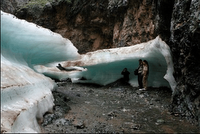
Gobi Gurvansaikhan park encompasses the series of ridges and valleys that make up the eastern end of the Gobi Altai mountains. Surrounded by low plains, the mountains rise to 2200-2600 meters, and include the Gurvan saikhan (three adjacent ridges named Zuun (East), Dund (Middle), and Baruun (West) saikhan), Zoolon, Sevrei, Gilbent, and Nemegt ridges. Some of the peaks are volcanic in origin.
 The park, which extends for more than 380 kilometers from east to west, lies at the northern edge of the Gobi desert but includes desert steppe and steppe at higher elevations. The park's landscape is extremely varied, with rocky and sandy desert plains, precipitous cliffs and ravines, salt pans, and oases. Gurvansaikhan includes the highest diversity of plant life in the Gobi Altai, with over 620 species of flowering plants. Most are characteristic of Central Asian deserts, including 38 endemic species. During years with adequate precipitation, desert plants produce vibrant summer displays of desert flowers.
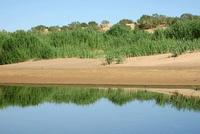 Fifty-two species of mammals are found here, including eight species listed in the Mongolian Red Book as endangered. Small herds of wild ass and black-tailed and Mongolian gazelle roam the desert valleys and desert steppe, while the mountains provide suitable habitat for threatened and endangered animals such as argali, Siberian ibex, and snow leopard. Long-eared hedgehogs and dwarf hamsters inhabit sandy areas. Over 240 bird species occur in the area, including 34 resident species, 99 breeding species, and 70 migrants.
Local herders seasonally graze livestock in parts of the park, which features some popular tourist destinations, including the Valley of Yol, a picturesque gorge, and the Singing Sands, a spectacular sea of sand dunes bordered by red sandstone formations, an oasis, and a saxaul forest. The Nemegt, Khermiin Tsav, Naran daats, and Bayanzag mountains, the sites of numerous important dinosaur fossil discoveries, also lie within the park.
Fifty-two species of mammals are found here, including eight species listed in the Mongolian Red Book as endangered. Small herds of wild ass and black-tailed and Mongolian gazelle roam the desert valleys and desert steppe, while the mountains provide suitable habitat for threatened and endangered animals such as argali, Siberian ibex, and snow leopard. Long-eared hedgehogs and dwarf hamsters inhabit sandy areas. Over 240 bird species occur in the area, including 34 resident species, 99 breeding species, and 70 migrants.
Local herders seasonally graze livestock in parts of the park, which features some popular tourist destinations, including the Valley of Yol, a picturesque gorge, and the Singing Sands, a spectacular sea of sand dunes bordered by red sandstone formations, an oasis, and a saxaul forest. The Nemegt, Khermiin Tsav, Naran daats, and Bayanzag mountains, the sites of numerous important dinosaur fossil discoveries, also lie within the park.
Friday, November 03, 2006
Baga gazar
The Baga Gazar mountain is a huge granite massive. Small hills with a rounded top are dominant. They are separated by small valleys without water flow. In this area weathering and erosion are intensive.
Argali and Sibirian ibex are found in this place.
GPS coordinate is 46°23'18.47"N, 105°39'3.23"E
Thursday, November 02, 2006
Zorgol khairkhan
This is a sacred mountain, found in the area of Bayan Unjuul soum of Tov aimag/province, about 150 km from Ulaanbaatar. The peak is 1686 m ASL. Zorgol Khairkhan Mountain is venerated and revered by the local people, who believe that it is the siege of a great, benevolent spirit. Many lines and stanzas were dedicated to this mountain in the famous poems of the modern poet B.Lkhagvasuren. The huge, red granite mountain does indeed have a diverse and beautiful nature to offer. It has many caves and water springs. Lucky visitors may see wild animals like mountain goats, ibex and eagles (at their nests). There are several burial sites of ancient Mongol soldiers around this mountain. According to shamanic custom, pronouncing the name of the holy mountains while visiting them is forbidden.
The mountain is composed of granite rock, being in the Granite belt of Mongolia.The mountain was mentioned as Zorgol Khan in the 'Secret History of Mongols'.
Mongolians have an ancient tradition of protecting and preserving the beautiful nature and landscape. The ancient legal manuscript called Khalkh Juram ordered the protection and preservation of fourteen mountains, including Bogd khaan, Khan-Khentii, Khugnu-Khaan and Zorgol-Khairkhan Mountains.


 hits
hits